
Small Business SEO
The Hardest SEO Keywords To Rank For Online
What’s Real and What’s Not Regarding The Hardest SEO Keywords To Rank For?
Every business owner dreams of ranking #1 for those golden, high-traffic keywords. The promise is intoxicating: thousands of potential customers, brand dominance, and a steady stream of leads. But reality hits hard. The more popular the keyword or search phrase is, the tougher the competition.
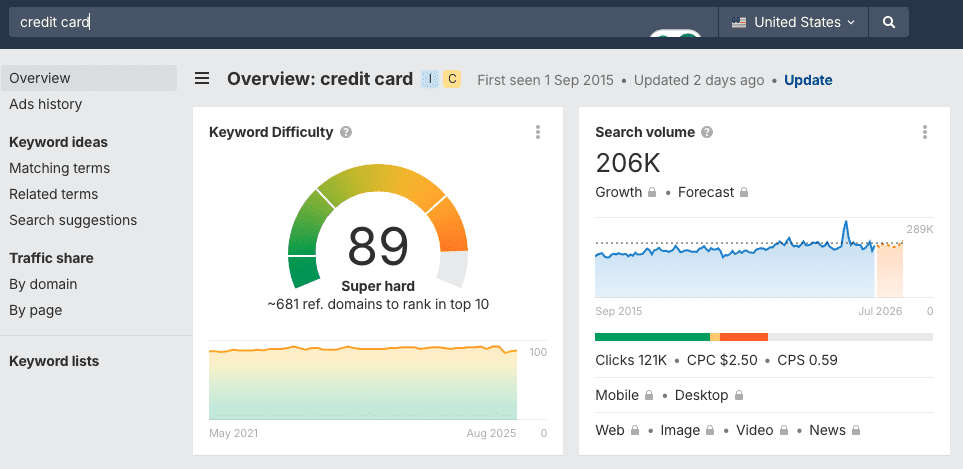
When people talk about “the hardest SEO keywords to rank for,” they often picture one-word giants like insurance, loans, or credit cards. While those examples are notoriously competitive, there’s no single master list of the world’s toughest keywords. Instead, keyword difficulty is relative. What determines a keyword’s difficulty level is shaped by your industry, competitors, website authority, and resources.
In this article we will cover:
- What makes a keyword truly difficult to rank for
- Review categories and examples of tough SEO Keywords
- Break down how to measure keyword difficulty using SEO tools and techniques
- Share actionable tips for deciding whether a keyword is worth pursuing
Part 1: What Are The Hardest SEO Keywords To Rank for?
The toughest keywords share several traits that make them inherently more competitive. Understanding these traits will help you quickly spot high-difficulty terms in your own keyword research.
Trait #1: They are Popular and Come With Massive Search Volumes
A keyword with tens or hundreds of thousands of monthly searches will attract attention from the biggest players in the industry. These organizations have dedicated SEO teams, established link profiles, and content budgets that can outpace most small to mid-sized businesses.
Trait #2: There is High Commercial Value
If a keyword is directly tied to big-money transactions, you can expect intense competition. Terms like personal injury lawyer, best business loan, or mortgage rates bring in clients or customers worth thousands, sometimes millions, over a lifetime. This means competitors are willing to invest heavily to secure rankings, often combining organic SEO with aggressive PPC bidding.
Trait #3: These SEO Keywords Are Dominated By High-Authority Brands
When page one of Google is filled with websites that have hundreds of thousands of backlinks, deep brand recognition, and massive marketing budgets, breaking into that space requires more than just solid content — it requires a sustained, multi-channel SEO effort over years.
Trait #4: Crystal-Clear Search Intent
Some keywords have an intent so specific that if your content doesn’t match it exactly, you won’t rank. For example, searchers for free logo maker expect a free tool they can use instantly. They are not looking for a blog post explaining how to make a logo. Deviating from that intent guarantees poor performance.
So, If The Hardest SEO Keywords To Rank For Are Searches, What Were the Most Popular Searches of Last Year?
Since this article is being published in August 2025, we need to look back at the year 2024. Below you will find the most trending searches on Google in 2025 based on Google’s official Year in Search Review Data.
Overall Trending Topics (Global)
-
Copa América — topped the list as the most searched topic worldwide.
-
UEFA European Championship
-
ICC Men’s T20 World Cup
-
India vs England — a specific cricket match that surged in attention.
News Events (Global)
-
U.S. Election — the most trending news topic globally.
-
Excessive heat — ranked second.
-
Olympic Games (Paris 2024)
-
Hurricane Milton
People / Personalities (Global)
-
Donald Trump, Catherine, Princess of Wales, Kamala Harris, Imane Khelif — among the most-searched individuals.
-
Liam Payne, Toby Keith, O.J. Simpson — top searches for passings.
Movies, TV & Entertainment (Global)
-
Inside Out 2 — most searched movie.
-
Deadpool & Wolverine, Saltburn, Beetlejuice Beetlejuice, Dune: Part Two — other top movie queries.
-
Baby Reindeer (Netflix) — top TV show search globally.
-
Fallout, House of the Dragon also trended highly in some regions.
Music & Songs (Global)
-
Not Like Us by Kendrick Lamar — the most searched song.
-
Other music trends included artists like Diddy, Usher, Sabrina Carpenter, and songs such as APT., Bling‑Bang‑Bang‑Born.
Games & Puzzles (Global)
-
Connections (The New York Times puzzle) was the top trending game search.
-
Other games: Palworld, Infinite Craft, Sprunki, Helldivers 2.
Food & Recipe Trends (Global)
-
Olympic chocolate muffins — the most-searched recipe (popularized by athlete Henrik Christiansen).
-
Other trending foods: Tanghulu, Tini’s mac and cheese, Mama Kelce’s cookie, Dense bean salad.
Aesthetics & Lifestyle Trends
-
Popular aesthetics included Mob Wife aesthetic, Nancy Meyers aesthetic, Pillow face aesthetic, Brat aesthetic, Decora aesthetic.
Maps & Places (Global)
-
Stadiums: Madison Square Garden, Yankee Stadium, MetLife Stadium, Barclays Center, Hard Rock Stadium.
-
Visitor attractions: Sphere (Las Vegas), Navy Pier (Chicago), Edge NYC, Kentucky Horse Park, Willis Tower.
Hum-to-Search Songs
People used Google’s “Hum to Search” feature most often for:
-
Beautiful Things — Benson Boone
-
Axel F — Crazy Frog
-
Wellerman — Santiano
-
Past Lives — Slushii
-
Too Sweet — Hozier

The Hardest SEO Keywords To Rank For By Category
Finance and Banking
- Keywords: Credit cards, personal loans, best mortgage rates, car insurance, business loan.
- Why They’re Tough: Big banks, fintech disruptors, and high-authority publishers like NerdWallet and Bankrate dominate these SERPs. They invest heavily in link-building, brand authority, and conversion-focused content.
Health and Wellness
- Keywords: Weight loss, CBD oil, best supplements, mental health counseling, yoga teacher training.
- Why They’re Tough: Google’s E-A-T guidelines (Expertise, Authoritativeness, Trustworthiness) mean that medical and wellness topics require expert authorship and impeccable sources. Combine that with fierce competition from established health publishers, and ranking is a long game.
Travel
- Keywords: Flights to Paris, hotels in New York, best all-inclusive resorts.
-
Why They’re Tough: Massive booking platforms (Expedia, Booking.com, TripAdvisor) dominate, along with Google’s own travel widgets, leaving little room for newcomers.
E-commerce Product Categories
-
Keywords: Best laptop, smartphone deals, running shoes, gaming chairs.
- Why They’re Tough:
Local Services in Major Cities
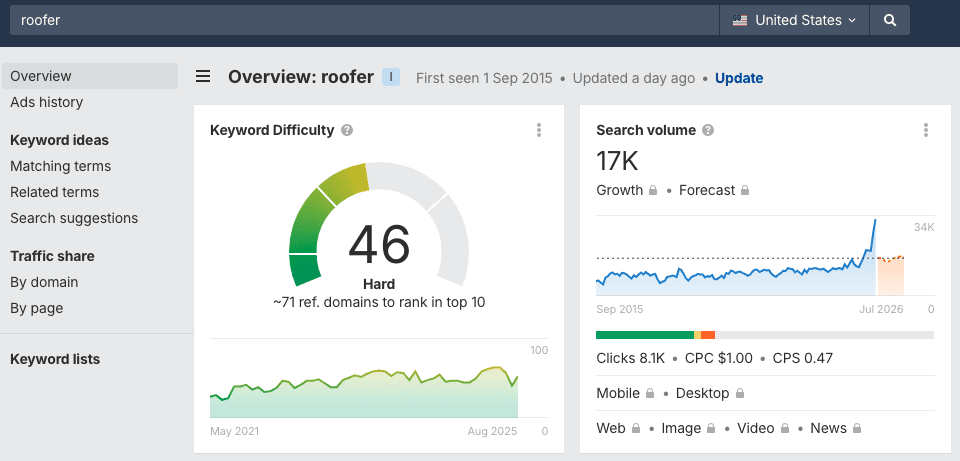
- Keywords: Plumber in New York, personal injury lawyer in Los Angeles, roofing contractor Chicago.
-
Why They’re Tough: These are high-value leads with high competition from local and national providers using aggressive SEO, paid ads, and directory listings.
Key Insight: The competitiveness isn’t just about the keyword itself — it’s about the ecosystem of players, intent, and commercial stakes surrounding it.
Part 2: Understanding Keyword Difficulty Level
Keyword Difficulty (KD) is more than just a number you see in an SEO tool — it’s a lens through which you evaluate your realistic chances of ranking.
Defining What Is Keyword Difficulty When It Comes to SEO
KD estimates how hard it would be to rank on the first page of Google for a specific keyword. Most tools score KD from 0–100, with higher scores meaning greater difficulty. But that number is only as good as the methodology behind it.
Why Does Keyword Difficulty Level Vary Between Tools?
Different tools weigh different factors: backlinks, domain authority, on-page optimization, SERP features, and even click-through rates. That’s why the same keyword might have a KD of 42 in Ahrefs, 58 in SEMrush, and 65 in Moz.
The Key Takeaway for Small Business Owners Regarding Keyword Difficulty Level
KD is a useful directional metric, but you must pair it with deeper SERP analysis to make sound decisions.
Part 3: How Ahrefs Calculates Keyword Difficulty?
Ahrefs keeps its KD calculation intentionally simple. They base their keyword difficulty level on the number of backlinks it requires to rank in the top 10 of search results.
Ahref’s Process for Measuring Keyword Difficulty
- Pull the top 10 ranking pages for the keyword.
- Count the number of referring domains pointing to each page.
- Assign a KD score based on the average backlink profile.
Ahref’s Backlink Benchmarks
-
KD 0–5 – Top-ranking pages have few or no backlinks.
-
KD ~50 – Hundreds of backlinks needed.
-
KD 90+ – Thousands of backlinks required.
This method is transparent and actionable: KD gives you a direct sense of how much link-building work you’re facing.
Part 4: Why Backlinks Aren’t The Whole Story When It Comes to Measuring Keyword Difficulty Levels
While backlinks are a powerful ranking factor, high KD scores don’t always tell the full story. Here’s what experienced SEOs also consider:
Backlink Quality vs Quantity
Not all backlinks are created equal. A single link from a high-authority, relevant site can outweigh dozens from low-quality domains.
Competitor Authority
High-authority domains have advantages beyond backlinks. Internal linking power and brand trust can boost rankings even without massive backlink counts.
Search Intent Alignment
If your content doesn’t match exactly what searchers expect, you’ll struggle to rank, no matter how many backlinks you have.
Content Quality
Quality is judged by accuracy, expertise, uniqueness, and user experience. This ties back to Google’s E-A-T principles and can be the deciding factor in close competitions.
Part 5: How to Determine Keyword Difficulty For Your Small Business
Here’s MarketKeep’s 6-Step Keyword Difficulty Analysis Framework, based on Ahrefs’ methodology but expanded for a more complete evaluation:
Pull SERP Data
- Use Ahrefs, SEMrush, or your tool of choice to list the top 10 results for your keyword.
Analyze Backlink Profiles
- Note the referring domains and backlink quality for each top-ranking page.
Evaluate Domain Strength
- Check Domain Rating (Ahrefs) or Domain Authority (Moz) to assess whether the competition consists of high-authority players.
Map Search Intent
- Identify what type of content currently ranks: blog posts, product pages, tools, videos, etc. Match your format accordingly.
Audit Content Quality
- Look for gaps you can fill, outdated information you can improve, or ways to offer more value faster.
Assess Your Own Resources
- Do you have the authority, link-building ability, and content production capabilities to compete?
Part 6: Should You Avoid The Hardest SEO Keywords to Rank For Online In Your Industry?
Not necessarily. While targeting lower-KD keywords can deliver quicker wins, high-KD keywords often drive the most valuable traffic.
When to Go After High-KD Keywords:
-
They’re central to your business model.
-
You’re willing to invest in long-term SEO efforts.
-
You can create content that’s genuinely better than what’s currently ranking.
Example: Ahrefs ranks for many KD 70+ terms, but it often took 4–5 rewrites and years of promotion to get there. The earlier you start on a high-value keyword, the sooner you can break into competitive SERPs.
Start Driving Qualified Traffic and Business To Your Website By Playing the Long Game
The toughest keywords to rank for are competitive because they’re valuable. By understanding keyword difficulty as both a metric and a concept and applying a structured analysis you can make informed decisions about which battles are worth fighting.
Whether you’re aiming for a quick win with a low-KD term or going all-in on a high-KD industry giant, success comes from preparation, patience, and persistence.
Ready to learn more about what works and what doesn’t in your industry? Request your Free SEO Meeting with MarketKeep to learn more about where you website currently whats and what you need to do so that you rank 1st in Maps, Search, and AI.

