
SEO for Deck Builders
SEO for Flooring Contractors Affordable SEO Packages With No Long-Term Contracts.
The Power of SEO for Deck Builders
99% of searchers never scroll past the first page of Google Search results. In fact, 42% of local searches click on results in the Google Map Pack, while a mere 0.44% of users ever bother to click through to the second page. These numbers highlight a clear reality: if you aren’t on page one, you’re invisible. But SEO for deck builders isn’t just about being seen; it’s about capturing high-intent leads at the exact moment they are ready to build.
Visibility Leads to High-Value Projects
When it comes to conversions, the data proves just how vital a strong digital presence is. 82% of local searches for “deck builder near me” result in a project being booked within 7 days. For a deck contractor, this means that the person searching isn’t just “window shopping”—they are ready to invest in their home’s outdoor living space immediately.
In a modern landscape where homeowners connect with builders through Google Maps, organic search, and even AI platforms like ChatGPT, Gemini, and Perplexity, ensuring your business is SEO-friendly is no longer optional. It’s the engine of your growth.
A Resource for Your Growth
At MarketKeep, as a digital marketing agency for small businesses, we want nothing more than the opportunity to help you dominate your local market. However, even if we don’t end up partnering together, we want to be a resource for your success.
While this is a service page for deck builders looking for professional small business SEO services, you can also use this page as a comprehensive guide to SEO for deck contractors and a roadmap for growing your business online.
Here Is What You Will Learn On This Page: SEO For Flooring Contractors
- The Importance of Keyword Research and Competitive Analysis
- Using Tools to Discover What Services People Look For
- Focusing on High-Intent/Long-Tail Keywords
- The Best SEO Keywords for Flooring Contractors
- Transactional SEO Keywords
- Informational SEO Keywords
- Your Website’s Sitemap Is Crucial When It Comes to SEO for Flooring Contractors
- Your Best Approach to Local SEO for Flooring Contractors
- Your Google Business Profile
- 6 Things to Prioritize Within Your Google Business Profile
- Building Local Citations
- Developing Your Strategy for On-Page SEO for Flooring Contractors
- Following the One Keyword Per Page Rule
- Creating Service Pages and Service Area Landing Pages
- Blogging
- Showcasing Completed Projects
- Implementing Technical SEO for Flooring Contractors
- Structured Data and Schema Markup for Flooring Contractors
- URL Structure
- SEO-Friendly URLs and Internal Linking Opportunities
- Mobile Optimization for Flooring Contractors
- Website Speed & Performance (Core Web Vitals)
- Frequent Technical Audits
- Off-page SEO for Flooring Contractors and Backlinking
- Understanding that Not All Backlinks Are Created Equal
- Guest Blogging & Link Intersects
- Local Citations
- PR, Awards, Badges, Recognition
- Tracking Success of Your SEO for Flooring Contractors
- Frequently Asked Questions for Flooring Contractors
- Partnering with MarketKeep an SEO Company for Flooring Contractors
- Our SEO Packages for Flooring Contractors
- Getting a Free SEO Evaluation From Our Team
Start At The Foundation: Keyword Research and Competitor Analysis for Deck Builders
When it comes to SEO for deck builders, you want to make sure you get it right the first time. Otherwise, you are wasting time, money, and missing out on high-value outdoor living projects. The best thing you can do is take a step back and truly invest in your keyword research and competitive analysis tools.
Keyword Research for Deck Builders
Before you start writing content or building backlinks, you need to know exactly what homeowners are typing into that search bar. To help you get a head start, we’ve compiled a comprehensive list of the Best SEO Keywords for Deck Builders that you can use to guide your strategy.
Beyond our guide, here are the primary tools we recommend for uncovering local search intent:
Google Keyword Planner
The best place to start is the Google Keyword Planner. Because it provides real-time data directly from the world’s largest search engine, it tells you exactly what homeowners are searching for, how often, and whether interest in specific services—like “composite deck installation” or “deck repair”—is trending up or down.
Furthermore, you can filter your SEO keywords for deck builders down to specific levels, such as:
- City
- State
- Service Area
This local filtering is extremely useful for growing your business in specific neighborhoods rather than just relying on broad, national trends.
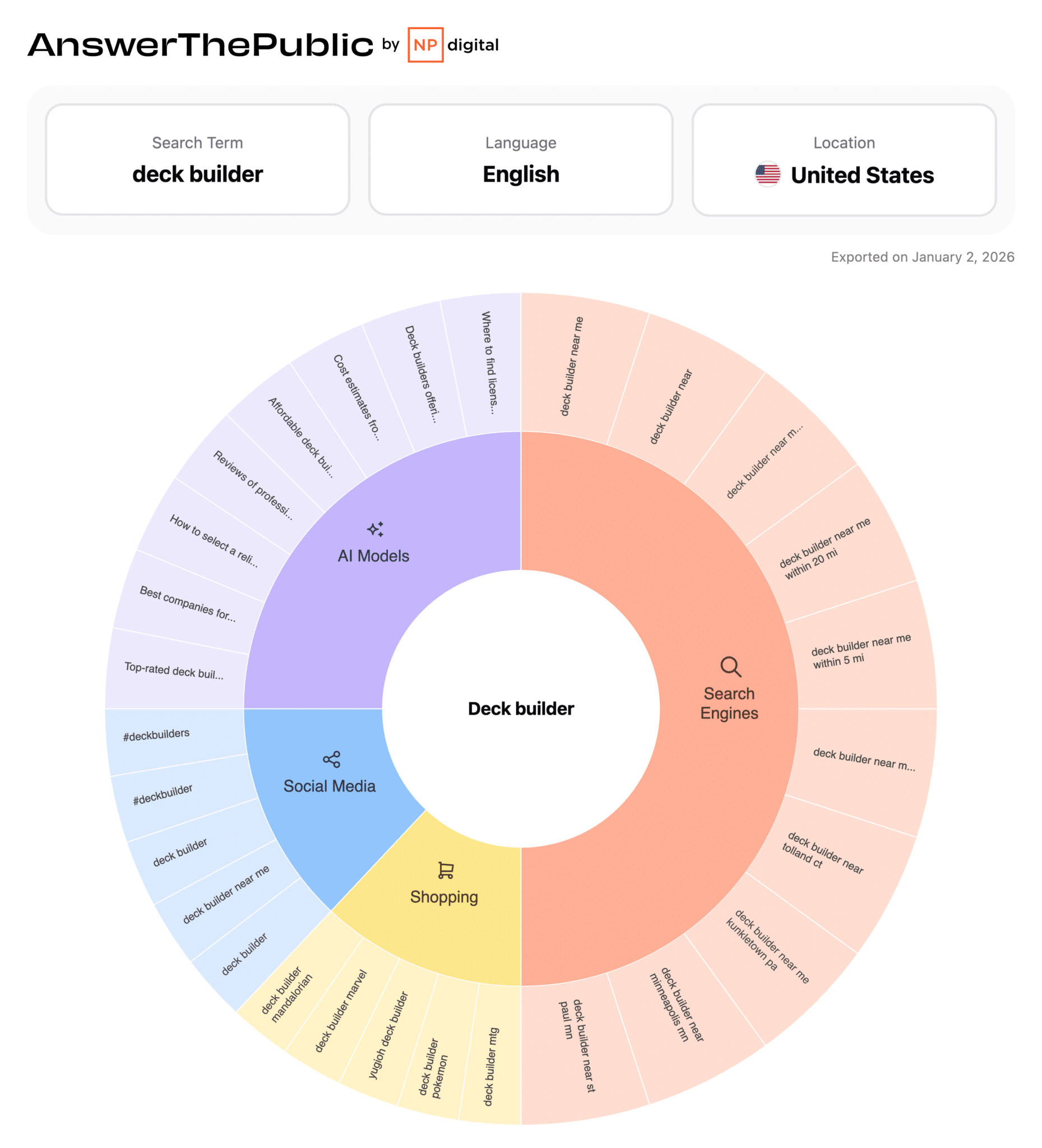
AnswerThePublic
This tool, developed by Neil Patel and his team, helps you visualize the exact questions your customers are asking online every day. By understanding these queries, you can create blog posts or FAQ sections that address homeowner concerns before they even reach out for a quote.
For example, if you go to their website and type in a search like “composite decking,” you will see a visualization of the “who, what, where, and why” of deck building. Scroll a bit further to see an example of what we are talking about!
By answering these specific questions on your website, you demonstrate Experience, Expertise, Authoritativeness, and Trustworthiness (E-E-A-T)—the key pillars Google uses to rank your business above the competition. It turns your website from a simple digital business card into a helpful resource that converts searchers into clients.
Site:YourCompetitor.com
Go to Google and type in the following prompt: site:competitordeckbuilder.com (replacing that with your actual competitor’s domain).
Typing this into Google filters out the noise and shows you every single page of your competitor’s website that is currently indexed and ranking on search engines. This is a goldmine for information because you can see exactly how they are structuring their business to attract homeowners.

When the results pop up, pay close attention to how they format their Search Engine Result Page (SERP) listing. Specifically, look at their Meta Title Tags and Meta Descriptions. These aren’t just random sentences; these are the specific keywords they are betting on to drive traffic.
By analyzing these results, you can uncover vital intel such as:
-
Service Gaps: Are they ranking for “under-deck drainage systems” or “custom pergolas” while you aren’t?
-
Service Areas: Are they targeting specific affluent neighborhoods or nearby cities through dedicated landing pages?
-
Content Commitment: Do they have a library of blog posts answering homeowner questions?
-
Social Proof: Do they have an indexed portfolio or case study pages showcasing their best deck builds?
Uncovering “Hidden” Landing Pages
A major bonus of the site: search tip is that it often reveals “hidden” landing pages. These are pages that might not be easily found in their main website menu but are specifically designed to rank for local searches like “Deck Builders in [Specific Suburb].” If they are using these “invisible” pages to capture leads in your backyard, you need to know about it so you can create a better version for your own site.
Using this prompt bridges the gap between keyword research and our next section, which dives deep into the importance of a comprehensive Competitor Analysis.
Developing a Competitor Analysis for Flooring Contractors
Understanding your competition is the key to outranking them. While you can learn a lot from a simple Google search, there are tools that allow you to look “under the hood” of their website to see exactly why they are ranking higher than you.
Detailed SEO Extension
This is an extension that you can install on your Google Chrome browser bar, and honestly, it’s a cheat code for deck contractors.
The Detailed SEO Extension is completely free to download and provides you with page-level insights into how your site is performing compared to any competitor in your market. Instead of guessing why a rival builder is appearing in the Map Pack, you can see their exact technical setup in one click.
Here is an example of the information you can gather from this tool to help your deck building business:

All of which you can use to develop your SEO strategy for your deck builder website.
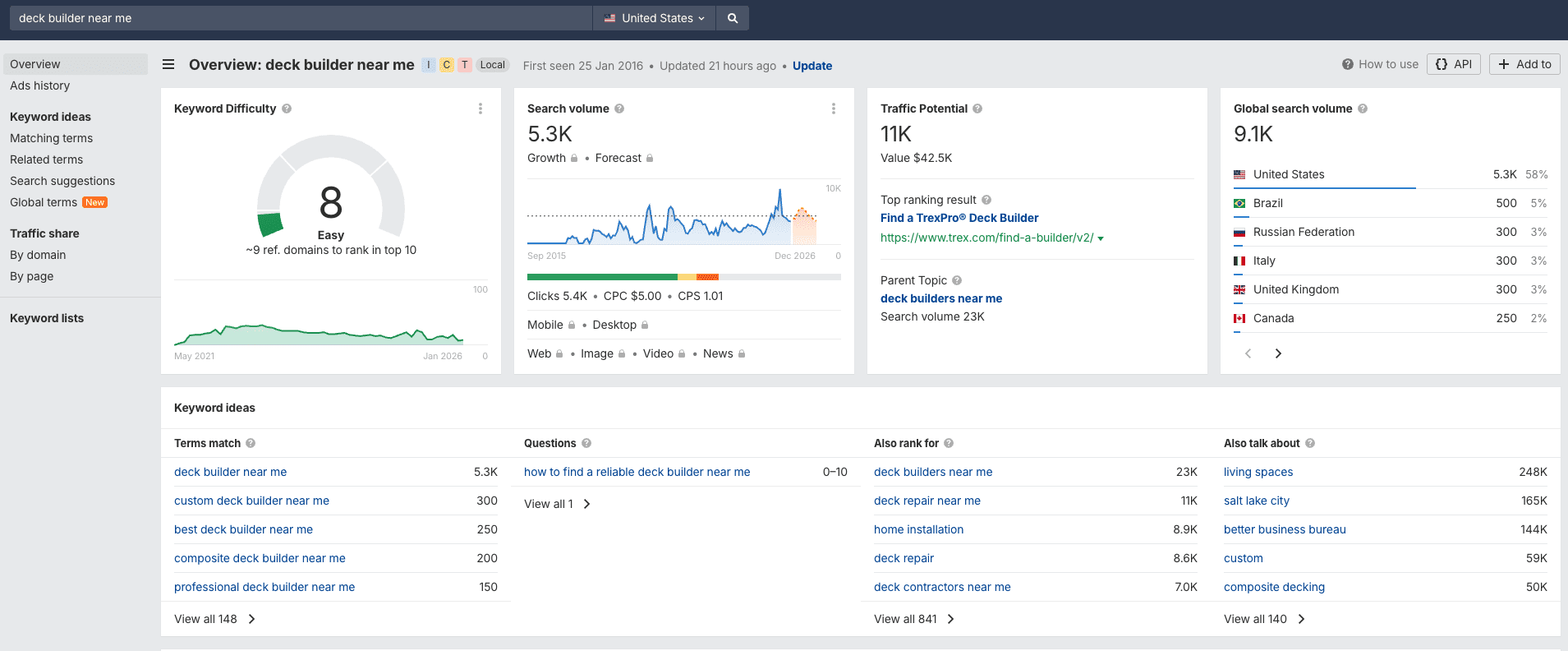
Ahrefs Keyword Explorer Report: Your Deck Building Roadmap
The next tool is a paid one, but we wouldn’t suggest it if we didn’t believe it was an absolute game-changer for your business. The Keywords Explorer report from Ahrefs has saved us from more headaches than we can count.
What we love about Ahrefs is that it provides a crystal-clear roadmap for your SEO strategy. It takes the guesswork out of content creation by giving you a Keyword Difficulty (KD) score from 0 to 100.
Navigating Keyword Difficulty
-
High Difficulty? No problem. If a keyword like “Deck Builders” has a high difficulty score, we know we need to settle in for the long haul. We’ll utilize all three pillars of SEO—Local, On-page, and Off-page—to gradually chip away at the competition.
-
Low Difficulty? That’s a win. If we find a “golden” keyword with a difficulty of 0 to 10 (like “curved composite deck installers” or “local deck permit requirements”), that is an immediate opportunity. As long as we write a high-quality page and request a URL inspection through your Google Search Console account, we can often see that page ranking almost immediately.
The “Triple Threat” Strategy
Whether we are using Google Keyword Planner for trends, “snooping” on the competition with the Detailed SEO extension, or mapping out a 12-month plan with Ahrefs, our goal is always the same. At MarketKeep, we have found that the most successful SEO for deck builders comes from a combination of these data points.
We use these tools to find the “low-hanging fruit” keywords that bring in leads today, while simultaneously building the authority needed to rank for the big-ticket terms tomorrow.
The Best SEO Keywords for Deck Builders
To maximize your presence as a deck builder, your keyword strategy needs to be as study as a reinforced deck frame (see what we did there).
Here is a the breakdown of the Eight Essential Keyword types specificially curated for deck builders to generate leads & dominate search.
1. Informational Keywords
These searchers are in the “learning” phase. They aren’t looking to hire today, but they are looking for an expert to guide them.
-
Examples: “How to clean composite decking,” “Do I need a permit for a deck in [City],” “Best wood for decks in humid climates.”
2. Navigational Keywords
These users are looking for a specific brand, whether it’s a material manufacturer or your specific company.
-
Examples: “Trex decking catalog,” “[Your Company Name] gallery,” “TimberTech warranty registration.”
3. Commercial Keywords
These searchers have decided they want a deck, but they are still comparing their options. They are looking for the “best” or “top-rated.”
-
Examples: “Best deck builders in [City],” “Composite vs. Wood decking cost,” “Top-rated deck designers near me.”
4. Transactional Keywords
These are your highest-converting terms. The searcher is ready to speak to a professional and start the project.
-
Examples: “Request a deck quote,” “Hire deck builder [City],” “Schedule a deck consultation.”
5. Branded Keywords
These keywords include your company name. You must own these results to prevent competitors from bidding on your name in ads.
-
Examples: “[Your Company Name] reviews,” “[Your Company Name] deck portfolio,” “[Your Company Name] address.”
6. Evergreen Keywords
These terms have steady search volume year-round. They are the “bread and butter” of your website traffic.
-
Examples: “Custom deck installation,” “Deck repair services,” “Pool deck builders.”
7. Trending Keywords (Time-Sensitive)
These represent current shifts in homeowner desires. In 2026, the focus is heavily on Multi-Zone Layouts and Technology Integration.
-
Examples: “Outdoor kitchen deck design,” “Decks with integrated LED lighting,” “Sustainable recycled composite decking”
8. Geo-Targeted Keywords
For a local contractor, these are non-negotiable. They ensure you show up when someone in your service area searches.
-
Examples: “Deck builders in [Your City],” “Custom decks [Your County],” “Deck contractor near [Specific Landmark or Zip Code].”
Your Website’s Sitemap Plays a Large Role In SEO for Flooring Contractors
our website’s sitemap is essentially your digital blueprint or roadmap. Just as you wouldn’t start a deck build without a structural plan, you shouldn’t run a website without an XML sitemap. It helps search engines understand the exact layout of your site and ensures homeowners can navigate your project galleries with ease.
For deck contractors, the sitemap serves as the vital bridge between your specialized service pages and the search engine bots that determine your local ranking.
4 Reasons a Sitemap is Crucial for Deck Builders
1. A Sitemap Speeds Up Discovery of New Services
If you expand your offerings—such as adding “Under-Deck Drainage Systems,” “Custom Gazebos,” or “Outdoor Kitchen Framing”—you want Google to find those pages immediately so you can start generating leads.
-
Without a sitemap: Google has to wait until it “crawls” your homepage and happens to follow a link to the new section.
-
With a sitemap: Google is automatically alerted to the new URL, often indexing it within hours, allowing you to show up for those new searches faster.
2. Organizing “Deep Content” (Your Project Portfolio)
Decking websites are notoriously image-heavy. You likely have dozens of project gallery pages like “Composite Deck in [Town A]” or “Pressure Treated Wood Deck in [Town B].”
-
These pages are often “deep” in your site architecture. Search engine bots have a “crawl budget”—they won’t stay on your site forever.
-
An XML Sitemap ensures the bot sees every single portfolio page without getting lost in your menu, ensuring your local work actually shows up in Google Image and local web searches.
3. Communicats “Freshness” to Search Engines
Deck building is highly seasonal. You likely update your site with new spring promos or winter maintenance tips (e.g., “How to protect your deck from ice and salt”).
-
A sitemap includes a tag called
<lastmod>(last modified). This tells Google exactly when a page was last updated. -
Google prioritizes “fresh” content. When you update a page with new decking trends or new pricing, the sitemap ensures Google re-scans that page to reward you for the update.
4. Prevents “Orphaned Pages”
As your business grows, you might create a specific landing page for a local home show or a “10% Off Deck Refinishing” special that isn’t linked in your main navigation menu.
-
These are called Orphaned Pages. Without a sitemap, Google might never find them.
-
A sitemap ensures these high-conversion landing pages are indexed and searchable, even if they are “hidden” from your primary header menu.
Here is an example of a well-performing Sitemap for Flooring Contractors

The Deck Builder’s Guide to the Google Map Pack: How to Rank #1 Locally
For deck builders, appearing in the Google Map Pack isn’t just a “nice-to-have”—it is the engine that drives high-value outdoor living projects. When homeowners search for terms like “deck builder near me” or “composite deck installation in [your city],” the companies that appear at the top of the Maps results typically receive the lion’s share of the clicks, phone calls, and site visits.
In the decking industry, where visual proof and local reputation are everything, a top spot on Google Maps serves as an immediate stamp of credibility.
How to Rank Your Deck Building Company on Google Maps
So how do you get your deck company to the top of Google Maps? It takes more than simply setting up a listing and walking away. Real results—the kind that fill your calendar with deck builds—come from a strategic mix of Google Business Profile (GBP) optimization, consistent review generation, and proven local SEO best practices.
The very first step you need to take is to fully optimize your Google Business Profile. For a deck builder, this means more than just entering your phone number; it’s about showcasing your craftsmanship through high-resolution project photos, selecting the correct service categories, and ensuring your service area is accurately mapped to the neighborhoods where you want to build.
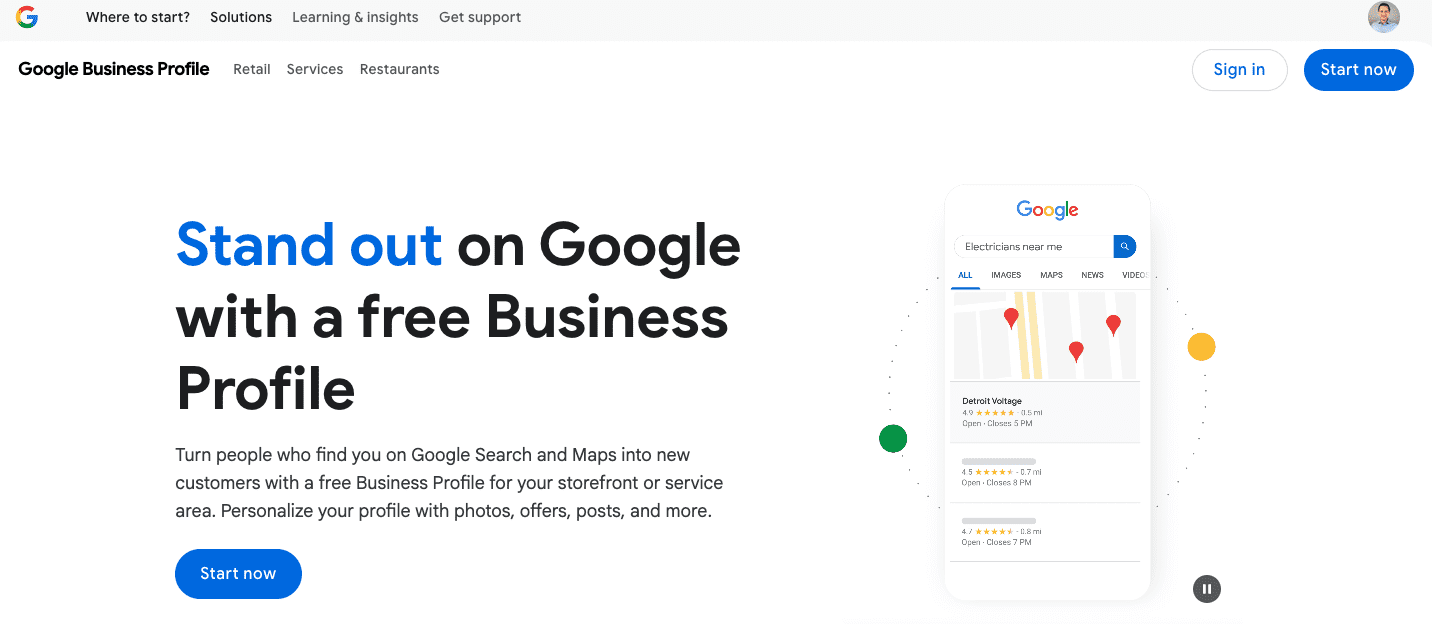
Step 1: Dominating the Local 3-Pack—Optimizing Your Profile for Maximum Leads
Your Google Business Profile (GBP) is the engine behind your visibility in the Google Map Pack. A fully built-out profile provides Google with the “trust signals” it needs to rank your business above other local contractors.
To make sure you are getting the most out of this free tool, you need to treat it like a digital showroom. Fill out every single detail—ensure your business name, categories, description, services, hours, and service areas are 100% complete and match your website exactly.
Add Service-Focused Language
Don’t just list “Construction” and call it a day. To rank for high-intent searches, you must use specific industry language that homeowners actually type into the search bar. Work these terms into your business description and service list:
-
Primary Category: Set this to “Deck Builder” (this is the most important step for relevance).
-
Secondary Categories: Include terms like “Gazebo builder,” “General contractor,” or “Paving materials supplier” if applicable.
-
Service Keywords: Naturally weave in terms like “composite deck installation,” “deck refinishing,” “custom porch construction,” and “multi-level deck design” so Google clearly understands the scope of your expertise.
By being specific, you tell Google and future customers that you aren’t just a “handyman,” but a specialized expert in outdoor living.
Step 2: Generate More Reviews (and make sure to respond)
Reviews play a massive role in how your deck building business performs on Google Maps. Beyond building trust with homeowners, they act as high-power ranking signals that tell Google your business is active, local, and reliable.
-
Request reviews immediately after the walkthrough: The best time to ask for a review is the moment you finish the final walkthrough and the customer is standing on their brand-new deck. Their excitement is at its peak!
-
Make the process effortless: Don’t make them search for you. Send a direct review link via text or email so they can leave feedback in seconds from their phone.
-
Respond to every single review: Acknowledge your fans and professionally address any concerns. Active engagement signals to Google that your business is legitimate and customer-focused.
-
Encourage keyword-rich feedback: When asking for a review, gently prompt them to mention the specific project. For example, instead of “They were great,” aim for feedback like: “The best composite deck builder in Towson! They handled our Trex installation perfectly.”
-
Post high-quality project photos regularly: For deck builders, “Before and After” shots are marketing gold. Upload photos of framed joists, finished decking, and unique features like built-in lighting or pergolas to build immediate credibility.
-
Use Google Posts for seasonal updates: Post weekly updates about recent completions, “Winter Booking” specials, or upcoming home shows. This keeps your listing “fresh” in Google’s eyes.
-
Master the Q&A feature: Pre-populate your profile with the questions you get asked at every estimate.
-
“Do you handle the building permits?”
-
“How long does a typical deck build take?”
-
“Do you offer financing for composite decking?”
-
Step 3: Keep Your NAP Information Consistent Everywhere
For a deck builder, your NAP is the structural foundation of your local search presence. NAP stands for Name, Address, and Phone Number. When these details are inconsistent across the web, Google loses confidence in your business’s legitimacy—which can quickly “sink” your rankings in the Google Map Pack.
Think of it like building a deck on unstable piers; if the base isn’t solid, the rest of the project is at risk.
Maintaining a Solid Local SEO Foundation
-
Audit industry-specific directories: Beyond just Google, review your business listings on platforms homeowners use to find contractors, such as Houzz, Angi, and the NADRA (North American Deck and Railing Association) directory.
-
Match formatting exactly: Your information should be identical everywhere. If your website says “123 Main Street, Suite B,” don’t use “123 Main St., #B” on Yelp. Even minor differences can confuse search engine bots.
-
Be careful with call tracking: If you use different phone numbers to track leads from various ads, ensure that your primary business phone number remains the consistent “anchor” across your core local citations and your Google Business Profile.
-
Update immediately after a move: If you move your showroom or home office, updating your NAP should be your first priority. “Zombie listings” with old addresses are one of the most common reasons deck builders see a sudden drop in local leads.
Step 4: Build Local Authority with Backlinks and Citations
Google Maps rankings are heavily influenced by your business’s “prominence”—which is a fancy way of saying how much the internet trusts you. The more high-quality, local websites that link back to your site, the stronger your presence becomes in the Map Pack.
-
Submit to High-Authority Contractor Directories: Beyond the big names like BBB, Houzz, and Angi, deck builders should aim for industry-specific authority. Getting listed in the NADRA (North American Deck and Railing Association) directory or appearing on a manufacturer’s “Certified Installer” locator (like Trex, TimberTech, or Azek) provides an incredible boost to your credibility.
-
Build Partnerships with Local Suppliers: Your local lumber yard, outdoor lighting specialist, or hardscape supplier has a website, too. Partnering with them for a “Preferred Contractor” link or a joint case study is one of the most effective ways to earn a geographically relevant backlink that Google loves.
-
Leverage Local Sponsorships: Sponsoring a Little League team, a community garden, or a local home expo does more than just get your name on a banner. It usually earns you a link from a
.orgor local community website. These “neighborhood thumbs-up” signals are exactly what Google looks for when deciding which builder to show in the #1 spot. -
Showcase Local Projects with Image Attribution: You take great photos of your finished decks. Offer those high-quality images to local real estate agents or neighborhood blogs to use in their content, in exchange for a link back to your portfolio as the photographer/builder.
Step 5: Build Content Around Flooring Services and Locations
Google doesn’t rank businesses in Maps based on distance alone—relevance and prominence are just as important. Your website content acts as the “proof” that Google needs to connect your business to the specific outdoor living projects homeowners are dreaming about.
To build that relevance, you need to structure your site like a well-planned deck: with a solid frame and specialized sections.
1. Create Individual Service Pages
Don’t just have one “Services” page. Creating a dedicated page for each core offering gives Google clear topical relevance.
-
Specialized Pages: Create separate pages for Composite Decking, Pressure Treated Wood Decks, Deck Refinishing, and Custom Pergolas.
-
The SEO Benefit: This allows you to rank for specific searches like “best composite deck builders near me” rather than just the generic “contractor” terms.
2. Develop Location Pages for Your Key Service Areas
If you want to show up in the Map Pack for surrounding towns where you don’t have a physical office, location-specific pages (or “Service Area Pages”) are your best tool.
-
Targeted Growth: Pages like “Deck Builder in [County Name]” or “Custom Decks in [Specific Neighborhood]” help you capture local demand in the exact suburbs where you want to work.
-
Local Signals: On these pages, mention local building codes, permit offices, or even local landmarks to prove to Google that you are truly active in that community.
3. Target Intent-Driven SEO Keywords
Use a data-backed keyword strategy to ensure your content matches real search demand.
-
Use a Resource: Tap into proven lists like our
Best SEO Keywords for Deck Builders -
Match the Intent: Ensure your “How-To” keywords (Informational) go on your blog, while your “Installation” keywords (Transactional) stay on your service pages.
Step 6: Improve Your Website's Technical SEO and Conversion Experience
1. Design for Mobile-First Homeowners
Most homeowners browsing Google Maps for “deck builders near me” are doing so from their smartphones—often while sitting in their current backyard dreaming of an upgrade.
-
The Strategy: Your site must be responsive, meaning it automatically adjusts to look perfect on a phone, tablet, or desktop. Large, touch-friendly buttons and easy-to-read text are non-negotiable for the “on-the-go” customer.
2. Speed is Your Competitive Advantage
In the construction world, time is money—and the same applies to your website. Google uses page speed as a ranking factor; a site that takes more than 3 seconds to load on a mobile device significantly increases your “bounce rate” (people leaving).
-
The Strategy: Compress high-resolution project images and use efficient coding to ensure your gallery of composite and wood decks loads instantly, keeping potential clients engaged.
3. High-Visibility Calls-to-Action (CTAs)
Don’t make a homeowner hunt for a way to contact you. If they have to search for your phone number, they will move on to the next builder in the Map Pack.
-
The Strategy: Place clear, bold buttons like “Request a Free Deck Estimate” or “View Our 2026 Project Gallery” at the top of every page. On mobile, use a “sticky” call button that stays at the bottom of the screen as they scroll.
4. Strategic Google Map Embedding
Embedding your verified Google Business Profile map directly onto your site does more than show where you are—it creates a “loop” of relevance between your website and your Maps listing.
-
The Strategy: Embed your map on your Contact Page and your Service Area Pages. This reinforces your geographic authority to Google, proving that you aren’t just a national brand, but a local expert serving that specific community.
Step 7: Use Advanced Local SEO Enhancements
Once the fundamentals are in place, advanced tactics are what allow your deck building company to break away from the pack. These strategies provide Google with “structured signals” that prove you are the premier outdoor living expert in your region.
Advanced SEO Tactics for Top-Tier Rankings
-
Implement Schema Markup: This is essentially “code for contractors.” By adding LocalBusiness and Service schema to your site, you give Google’s bots a clear, structured list of your location, operating hours, and specific services. Using Review Schema can even allow your star ratings to show up directly in the organic search results, significantly increasing your click-through rate.
-
Use Location-Driven CTAs: Don’t settle for a generic “Contact Us” button. Use specific, localized calls-to-action like “Schedule a Composite Deck Estimate in Towson” or “Start Your Custom Deck Design in Harrisburg.” This constantly reinforces the connection between your service and your location to search engines.
-
Optimize Your Project Images for SEO: You likely have hundreds of photos of your work. Don’t just upload them as “IMG_001.jpg.” Rename them to descriptive, keyword-rich phrases like “multi-level-trex-deck-annapolis” and include Alt Text that describes the project. This helps you show up in Google Image searches when homeowners are looking for design inspiration.
-
Leverage Short-Form Video Content: In an era of AI-driven search, video is a major trust signal. Posting a 30-second “deck frame walkthrough” or a video testimonial from a happy homeowner on their new porch helps your business stand out. These videos can be embedded on your site and shared on your Google Business Profile to boost engagement and “time-on-site” metrics.
Incorporating On-Page SEO for Deck Builders
The key to on-page SEO for deck builders is remembering the “Rule of One”: for every page on your site, you should focus on one primary keyword. While a single high-quality page can naturally rank for hundreds of related terms (like “deck installers” and “deck builders near me”), having one clear focus prevents your pages from competing against each other.
To build a page that both homeowners and Google love, your primary SEO keyword should be placed strategically in the following “foundational” locations:
-
The H1 Title Tag: This is the main headline of your page (e.g., Custom Composite Deck Builders in [Your City]).
-
The First Paragraph: Work your keyword into the first 2-3 sentences of your text to establish relevance immediately.
-
An H2 Header: Use your focus keyword in at least one major subheading.
-
Additional H2 & H3 Headers: Use variations of your keyword (like “local deck construction”) in other subheaders to create a clear content hierarchy.
-
Natural Body Text: Include the keyword a few more times throughout the copy, but keep it natural—avoid “keyword stuffing” which can hurt your rankings.
-
Image Alt Text: Since deck building is a visual business, ensure your project photos have descriptive alt text like “New multi-level Trex deck in [Your City].”
Strengthening Your Digital Frame with Links
Just as a deck needs solid joists and beams, your webpage needs a strong link structure to stay authoritative. To maximize your SEO performance, ensure every page contains:
-
At Least 2 Inbound (Internal) Links: These are links from other pages on your site (like a blog post about decking materials) pointing to this service page. This passes “link equity” and helps Google find your content.
-
At Least 3 Outbound (External) Links: Link out to high-authority, non-competitor resources. For a deck builder, this could be a link to the local building permit office, a major manufacturer’s warranty page (like Trex or TimberTech), or the NADRA (North American Decking and Railing Association) website.
Adapting a Local SEO Approach to On-Page SEO for Deck Builders
Whether you are an independent deck contractor or a large outdoor living firm, localizing your website is the most effective way to dominate your local market.
For deck builders, your SEO strategy should prioritize Service Area Pages (also known as “Areas We Serve” pages). These are dedicated landing pages for the specific cities and neighborhoods where you build. If you are based in one town but want to win high-end composite decking projects in the neighboring affluent suburbs, these pages are your secret weapon.
The Deck Builder’s Local SEO Module
On-page SEO for deck contractors should follow a specific hierarchy to avoid “keyword cannibalization” (where your own pages compete against each other):
-
The Homepage: This is your “Authority Hub.” It should target broad, high-volume terms that represent your entire business without being tied to a single tiny suburb. If you are a deck builder in Phoenix, Arizona, your homepage should establish you as a premier Arizona Deck Contractor.
-
Service Pages: These focus on what you do (e.g., “Composite Decking,” “Pool Decks,” “Deck Lighting”).
-
Location Pages: These focus on where you do it (e.g., “Deck Builders in Scottsdale,” “Custom Decks in Mesa”).
Anatomy of a High-Ranking Location Page
To make your “Areas We Serve” pages rank, they need to be more than just a copy-paste of your homepage with a different city name. Each page should include:
- Localized H1 Header: e.g., “Expert Deck Building & Design in [City Name], [State]”
- Neighborhood Mentions: Reference specific local landmarks, parks, or well-known subdivisions. This proves to Google you truly know the area.
- Local Project Gallery: Feature photos of decks you’ve actually built in that specific town.
- Localized Reviews: Embed testimonials from clients who live in that city.
- Local Map Embed: A Google Map pinned to that service area reinforces your geographic relevance.

Service Page Example
To show up for high-intent searches in the competitive outdoor living market, your website and Google Business Profile must act as a unified team. This means building a digital structure that reflects the specific projects you want to build and the exact towns where you want to build them.
Instead of hiding all your expertise on one generic “Services” page, you should break your site down into specialized “Blueprints” that Google can easily index:
1. Dedicated Decking Service Pages
Creating individual pages for your core services allows you to rank for specific materials and project types rather than just a broad “contractor” term.
-
Examples: Composite Decking (Trex/TimberTech), Natural Wood Decks, Deck Refinishing & Repairs, Screened-In Porches, and Custom Pergolas.
2. Hyper-Local Service Area Pages
If you want to win more jobs in the most profitable neighborhoods, you need dedicated location pages.
-
Example: Create a page for “Deck Builder in Phoenix” or “Custom Decks in Scottsdale.” This tells Google you are a local authority in that specific community, increasing your chances of appearing in the Google Map Pack for those residents.
3. Supporting “Decision-Stage” Blog Content
Use your blog to answer the specific questions homeowners ask before they sign a contract.
-
Example: “How much does a composite deck cost in Phoenix?” or “Do I need a building permit for a deck in Maricopa County?” By organizing your site this way, you make it easy for search engine bots to see that your business is the perfect match for a homeowner searching for a high-quality deck builder in their neighborhood.
WordPress Tools We Use to Help With Deck Builider SEO
Programs like Wix and Squarespace have their own dedicated SEO section. WordPress websites allow you to customize your website settings and tools which is why we prefer WordPress.
When it comes to SEO for flooring contractors there are two plugins that we trust. Yoast SEO and All-In-One SEO or AIOSEO.

Yoast SEO for Flooring Contractors
Yoast SEO powers over 13 million websites, making it the most trusted WordPress plugin for contractors looking to scale their online presence. For a deck builder, Yoast acts as your “site supervisor,” ensuring every page you publish is structurally sound for search engines and easy for homeowners to read.
Yoast makes SEO effective, reliable, and easy to manage by taking the guesswork out of your digital marketing.
Real-Time Feedback on Your Craftsmanship
Just as you wouldn’t leave a job site without a final walkthrough, Yoast provides a “traffic light” system that gives you real-time feedback on your content. It ensures your pages are properly optimized for the phrases homeowners are actually searching for, like “composite deck installation” or “local deck repair.”
-
SEO Analysis (The Green Light): Yoast checks if you’ve used your focus keyword in the right places—like your H1 title, your first paragraph, and your image alt text. When you see the green light, you know your page is ready to compete in the rankings.
-
Readability Analysis: Homeowners want to understand your process, not get lost in industry jargon. Yoast analyzes your sentence length and structure to ensure your “How-To” guides and service descriptions are clear, engaging, and easy to scan on mobile devices.
-
Automated Technical SEO: Behind the scenes, Yoast handles the “heavy lifting.” It automatically generates XML sitemaps to help Google find your latest project galleries and adds Schema markup so your business details show up correctly in local search results and the Google Map Pack.

All-In-One SEO Plugin
While many contractors start with Yoast, we have found that All-In-One SEO (AIOSEO)is often the superior choice for deck building businesses looking to scale. It is designed to take the technical “heavy lifting” off your plate, allowing you to focus on the job site while the plugin handles your digital foundation.
AIOSEO makes it incredibly simple to optimize your website without needing to be a coding expert. It streamlines your page titles, meta descriptions, and sitemaps so your specific service pages—like “Composite Deck Installation”—and your location pages rank higher where it matters most: in your local community.
The Competitive Edge for Growing Contractors
As your business grows—perhaps expanding from one county into three or adding new high-ticket services like “Under-Deck Drainage Systems”—AIOSEO keeps your website organized and search-friendly. It reduces common SEO mistakes by providing clear, actionable “TruSEO” scores and handling complex behind-the-scenes settings automatically.
Advanced Local Authority with Schema Markup
One of the primary reasons we have been transitioning our clients toward AIOSEO is its superior control over Schema Markup. Schema is a specific type of code that acts as a direct line to Google and AI-driven search engines (like ChatGPT and Perplexity). It tells them exactly:
-
What you do: (e.g., “Deck Building Contractor”)
-
Where you are: (Your exact service area and office location)
-
What others think: (Pulling in your star ratings and reviews)
By providing these clear “structured signals,” AIOSEO helps your deck building company appear in Rich Results (those eye-catching listings with star ratings and photos) and local map features. In a competitive market where every builder claims to be the “best,” this professional, data-rich search appearance is often the extra edge that wins the lead.
Implementing Techincal SEO for Deck Builders
Technical SEO is the digital foundation of your business. Just as a deck is only as stable as the footings and framing beneath it, your SEO strategy relies on a website that search engines can easily crawl, understand, and trust. For deck builders, strong technical SEO ensures that your high-value service pages—like “Custom Composite Decks” or “Screened-In Porches”—rank high enough to capture homeowners at the exact moment they are ready to build.
Structured Data and Schema Markup
Structured data, also known as Schema Markup, is a specialized code that helps search engines identify exactly what your deck building business does and where you work. By adding schema for Local Business, Construction Services, Reviews, and FAQs, you provide Google and AI-powered search engines with clear context.
This increases your chances of appearing in Rich Results (search listings that display star ratings and prices) and AI-generated summaries. In a competitive market, Schema is the difference between being just another contractor and being the “Recommended” local expert.
URL Structure and Local Keyword Integration
Clean, organized URLs help both users and search engines navigate your site structure. By creating SEO-friendly URLs that include your specific service and city, you make it easier for Google to connect your business with local searches.
-
Good URL:
yourdeckcompany.com/composite-deck-installation-annapolis-md/ -
Bad URL:
yourdeckcompany.com/service-page-1/
A clear URL structure also creates natural opportunities for Internal Linking between your material-specific pages (like Trex or Ipe wood) and your city-specific pages.
The Importance of Internal Linking
Internal linking is the “framing” that connects your website together. It distributes authority across your site and guides Google to your most important pages. By strategically linking your blog content (e.g., “How much does a deck cost in 2026?”) to your service pages (e.g., “Custom Deck Design”), you help Google understand your topical relevance.
For deck contractors, internal links also keep homeowners on your site longer—moving them from a gallery photo to a review page, and finally to your “Request an Estimate” form.
Mobile-Friendliness for Flooring Contractors
Most homeowners are searching for deck builders on their phones, often while standing in their own backyard. A mobile-friendly website ensures your project galleries load perfectly, your text is readable, and your “Call Now” button is easy to tap.
Because Google uses mobile-first indexing, your mobile site is the version used to determine your rankings. If your site is difficult to use on a smartphone, your local search performance will suffer, regardless of how good your craftsmanship is.
Website Speed & Performance
Speed directly impacts your conversion rate. Slow-loading pages—often caused by massive, unoptimized project photos—increase bounce rates and frustrate potential clients.
-
Optimize Images: Compress your high-res deck photos so they look great but load fast.
-
Eliminate Bloat: Remove unnecessary code to improve performance across all devices.
Taking Advantage of Techincal Audits
A technical SEO audit identifies the hidden “structural rot” in your website, such as crawl errors, broken links, or indexing problems that prevent your new project pages from showing up in search results.
By conducting regular audits, you can fix issues before they impact your lead flow. This is especially vital as you add more service areas and project photos to your site. To get started with a technical audit, we recommend tools like: Screaming Frog, Ahrefs Site Audit, or the Google PageSpeed Insights tool.
Off-Page SEO for Deck Builders and the Power of Backlinks
Off-page SEO is everything that happens away from your website to help Google and other search engines trust your deck building company. While on-page SEO is about your content and technical setup, off-page SEO is entirely about building authority.
The most effective way to build this authority is through backlinking. Backlinks are links from other websites that point to yours; in the eyes of Google, they act as professional endorsements. For deck builders, a strong off-page strategy helps you outrank competitors for “big ticket” projects like multi-level composite decks and improves your visibility in the Google Map Pack.
Not All Backlinks Are Created Equal
Before building links, you must understand that quality far outweighs quantity. In fact, “spammy” or irrelevant links can actually harm your rankings.
A link from a trusted, relevant source—like a national decking material manufacturer (Trex/TimberTech), a local home builders association, or a regional home-and-garden magazine—is worth more than a thousand links from random directories. Google looks for relevance. The best links for a deck contractor come from sites related to outdoor living, architecture, home remodeling, and your specific local community.
Guest Blogging and Link Intersects
Guest blogging is a powerful way to earn “earned media” while building your brand. This involves writing an expert article for a partner’s website—such as a local landscaper, an outdoor lighting company, or a real estate blog—in exchange for a link back to your site.
-
Example: You write “5 Trends in Modern Deck Design” for a local realtor’s blog, linking back to your Service Area Page.
Link Intersects take this a step further. By using tools like Ahrefs, we can see which websites are linking to your top 3 local competitors but not to you. If a local “Home & Garden” site links to three other deck builders in town, they are highly likely to link to you as well if you reach out with high-quality project photos.
Local Citations: The Foundation of Maps
For deck builders, local citations (mentions of your Name, Address, and Phone Number) are vital. Even if the site doesn’t provide a clickable link, the mention itself confirms your business’s legitimacy to Google.
Key citation sources for the decking industry include:
-
Industry Specific: NADRA (North American Decking and Railing Association), Houzz, and Angi.
-
General Local: Yelp, BBB, and your local Chamber of Commerce.
-
Accuracy is Key: Your NAP (Name, Address, Phone) must be identical across all these platforms to support your Google Maps rankings.
PR, Awards, Badges, and Brand Recognition
Recognition-based backlinks are the “Gold Medal” of off-page SEO. When your deck company is featured in a local news story about a community project, wins a “Best of the County” award, or earns a “Certified Pro” badge from a major manufacturer, the resulting link carries massive authority.
Pro Tip: Once you earn these awards or badges, place them prominently in your website footer and on your “About Us” page. They don’t just help with SEO; they are powerful conversion tools that give homeowners the confidence to choose you over a lower-priced competitor.
SEO Isn’t Set It and Forget It. Here is How to TrackYour Success for Deck Builders
SEO for deck builders isn’t a one-time project; it’s a strategy that you measure, refine, and improve over time. The good news is that you don’t need a complex data science degree to understand if your SEO is working.
With the right tracking tools, you can see exactly how many homeowners are finding your portfolio, which decking keywords (like “composite deck installation”) are driving the most traffic, and—most importantly—how many phone calls and estimate requests your efforts are producing.
Here are the three essential platforms we use at MarketKeep to track the success of our SEO for deck builders:
Google Analytics
Google Analytics helps deck builders understand what happens after a homeowner clicks onto your website. It tracks the journey from the first click to the final “Request an Estimate” form submission.
With Google Analytics, you can track:
-
Website Traffic Growth: Monitor the increase in organic visitors finding you through Google Search.
-
Top-Performing Service Pages: See which materials (Trex, Ipe, Cedar) or project types (Pool Decks vs. Screened Porches) are generating the most interest.
-
Service Area Traction: Identify which specific towns or counties are attracting the most local homeowners to your site.
-
Conversion Events: Track exactly how many people clicked your “Call Now” button or completed your lead intake form.
-
Engagement Metrics: See how long visitors spend looking at your project galleries—longer “dwell time” on your portfolio usually signals a high-intent lead.
For a deck builder, this is vital because SEO success isn’t just about traffic; it’s about qualified homeowners in your service area inviting you out for an estimate.
Google Search Console
If Google Analytics tracks the user on your site, the Google Search Console shows you how your flooring website performs inside Google Search itself. Think of it as your SEO command center. The GSC tells you which keywords you’re ranking for, how many people are clicking on your site, and whether Google is having any trouble crawling your pages.
Search Console helps you track:
- Keyword rankings and search queries (e.g., “hardwood installation [Town]”)
- Impressions vs. clicks (how often you’re showing up vs. how often people choose you)
- Click-through rate (CTR) to see if your page titles and descriptions are compelling
- Indexing issues that could prevent pages from ranking
- Page Experience and Core Web Vitals that impact performance and usability
For flooring contractors, Search Console is especially valuable for identifying which service pages and city pages are gaining traction, and spotting keyword opportunities you can expand into new pages.
Google Business Profile Insights
For deck builders, many leads are won or lost in the Google Map Pack before a homeowner even visits your website. This tool measures the exact actions taken on your local listing.
Google Business Profile Insights helps you monitor:
-
Maps vs. Search Views: See how many people found you while browsing the map versus a standard search.
-
Direct Phone Calls: Track how many homeowners clicked the “Call” button directly from your Maps listing.
-
Direction Requests: A high number of people looking for directions to your showroom (if you have one) is a massive signal of local intent.
-
Photo Performance: Compare how many views your deck project photos get compared to other builders in your area.
-
Search Queries: See the exact phrases homeowners used that triggered your profile to appear in the Local Pack.
Frequently Asked Questions About SEO for Flooring Contractors
What is SEO for Deck Builders?
SEO for deck builders is the strategic process of optimizing your website and Google Business Profile to ensure homeowners find your company when searching for outdoor living services. This involves keyword targeting, building material-specific pages (like composite or wood), location-based landing pages, Google Maps optimization, and technical improvements that turn searchers into scheduled estimates.
How long does SEO take to work for a deck contractor?
Most deck contractors see early visibility shifts within 30–90 days, particularly in Google Maps and for “niche” keywords like “deck resurfacing.” Because deck projects are high-ticket items with a longer research phase, consistent SEO efforts typically yield significant lead volume increases in the 3–6 month range, with authority continuing to compound over time.
Is Google Maps optimization part of SEO for Deck Builders?
Absolutely. For a local contractor, Google Maps optimization is arguably the most vital component. Appearing in the Map Pack puts your business in front of homeowners at the exact moment they search for a “deck builder near me,” leading to immediate phone calls and project inquiries.
What are the best SEO keywords for Deck Builders?
The best keywords combine intent with geography. Examples include “composite deck installation [City],” “custom deck builders near me,” “iPe wood decking contractor,” and “screened-in porch construction [City].” A winning strategy targets both transactional keywords (homeowners ready for a quote) and informational keywords (homeowners researching materials like Trex vs. Wood).
Should deck builders create separate pages for each town they serve?
Yes. If you want to rank in affluent suburbs 20 miles from your main office, you need Location Pages. These pages tell Google you are a local authority in that specific town. To avoid “duplicate content” issues, ensure each town page features unique text, local project photos, and mentions of specific building codes or permit offices.
Do Deck Builders need to blog for SEO?
While not mandatory, blogging is a powerful tool for building trust. Articles like “The Cost of a Composite Deck in 2026” or “How to Prepare Your Deck for Winter” attract homeowners during the research phase. This allows you to capture leads months before they are ready to build, keeping your brand top-of-mind.
What is Schema Markup and Why Does It Matter for Deck Contractor SEO?
Schema Markup is a “digital blueprint” for search engines. It helps Google and AI-driven platforms like ChatGPT or Gemini understand your business hours, service areas, and star ratings. For deck builders, Schema can help your 5-star reviews show up directly in search results, making your listing more “clickable” than the competition.
What is technical SEO and why is it important for deck builders?
Technical SEO ensures your website is fast, secure, and mobile-friendly. If your high-resolution project galleries take too long to load on a mobile device, homeowners will “bounce” back to the search results. Technical SEO fixes the “behind-the-scenes” issues so your craftsmanship actually gets seen.
How do backlinks help deck builders rank higher?
Backlinks are like professional endorsements. When a reputable site—like a decking manufacturer (TimberTech), a local home builders association, or a local news outlet—links to your site, Google sees you as a trusted authority. This “vote of confidence” is one of the top factors for ranking in competitive markets.
How can deck builders track SEO results?
We recommend using Google Analytics (to track website leads), Google Search Console (to see which keywords you rank for), and Google Business Profile Insights (to track phone calls and Map views). These tools provide the “data evidence” that your marketing budget is working.
Is SEO better than Google Ads for Deck Builders?
They work best as a team. Google Ads are like a light switch—they generate leads instantly but stop the moment you stop paying. SEO is like an investment in your own property; it takes time to build, but it produces “free” organic leads for years to come. Many builders use Ads to fill the schedule now while SEO builds long-term equity.
How much does SEO for Deck Builders cost?
Pricing varies based on your local competition and how many service areas you want to dominate. Because SEO results compound over time, it is usually an ongoing investment. The best first step is a Free SEO Evaluation to see exactly what is needed to outrank your local competitors.
Partnering With MarketKeep
At Marketkeep we pride ourselves on being the digital marketing agency for small businesses.
We understand that in the construction industry, no two projects are the same—and we believe your marketing should be handled with that same level of craftsmanship. That is why we don’t just offer “one-size-fits-all” SEO packages.
Instead, we customize each of our SEO strategies for deck builders to ensure they align perfectly with your specific budget, your service area, and your long-term growth aspirations. Whether you are looking to dominate a single county or expand your footprint across the state, we build the digital framework to get you there.
If you are looking for an SEO plan that will connect you with homeowners in the moments that matter most—when they are ready to invest in their outdoor living space—and fits within your business’s budget, let’s talk.
Give us a call today or click the button below to receive your Free SEO Video Review and see how we can help you outbuild the competition.
SEO Packages for Deck Builders
Starter SEO Package
Starting at $350 per month
Perfect for businesses just beginning their SEO journey or those with clearly defined service areas, our Starter SEO Package provides a strong foundation for long-term growth.
What’s included:
- Initial keyword research and opportunity analysis
- Competitor analysis (up to 2 competitors)
- Monthly site health audits with priority fixes
- Google Business Profile optimization and management
- Monthly posting
- Photo optimization
- Service updates
- 35 local citations (one-time setup and cleanup)
- On-page SEO for existing core pages
- Meta titles and descriptions
- Heading structure
- Internal linking
- Image optimization
- 12SEO-optimized blog post per month
- Conversion tracking setup (calls and form submissions)
- Monthly performance reporting
- 1 strategy Zoom call per month
This package is ideal for businesses seeking an affordable SEO package that establishes visibility without overcommitting.
Foundation SEO Package
Ranges from $550 – $850 per month
Our most popular option, the Foundation SEO Package is designed for businesses ready to build consistent momentum with structured monthly growth.
Everything in thr Starter Package, plus:
-
Expanded on-page optimization across additional service pages
-
2 SEO-optimized content pieces per month
-
Blogs or service page expansions
-
-
Monthly content and keyword planning
-
Ongoing technical SEO improvements
-
Enhanced Google Business Profile growth strategy
-
Early authority-building and backlink outreach
-
More detailed performance reporting
-
Bi-weekly strategy calls
This package is ideal for businesses seeking an affordable SEO package that establishes visibility without overcommitting.
All-In SEO Package
Starts at $850 per month
Our most comprehensive offering, the All-In SEO Package is built for businesses competing in aggressive markets or looking to dominate local search results.
Everything in the Foundation Package, plus:
-
3–4 SEO-driven content assets per month
-
Blogs, service pages, and location-based content
-
-
Strategic internal linking and topical authority building
-
High-quality backlink acquisition and digital outreach
-
Advanced technical SEO and site optimization
-
Conversion rate optimization insights
-
Competitive monitoring and counter-strategies
-
Advanced Google Business Profile optimization and review velocity strategies
-
ROI-focused reporting tied to lead generation
-
Weekly strategy calls and priority support
This package is ideal for businesses that view SEO as a core growth channel — not an experiment.