
Two Flooring Companies. Same City. One Gets 586 Visitors a Day - The Other Gets 1.
Two hardwood flooring companies operate in the same city. They serve the same customers, offer the same services, and compete for the same jobs. One of them generates 586 organic website visitors every single day. The other generates exactly 1.
This is not a story about one company outspending the other on advertising. Neither of them runs paid ads. It is not about social media following, brand reputation, or years in business. The gap you are looking at comes down to one thing: how each company built — or failed to build — their website around the right SEO keywords.
Duffy’s Floors, a hardwood floor specialist in Boston, MA, has 90 keywords driving organic traffic to their site every day. Eagle Hardwood Flooring, also operating in the Boston market, has 1. The Ahrefs data tells the story in black and white:
Duffy’s Floors – Ahrefs Site Overview

| Domain Rating | 9/100 |
| Organic Keywords | 90 |
| Organic Traffic | 586 visitors / day |
| Backlinks | 226 |
| Referring Domains | 94 |
| AI Search Appearances | 51 citations across AI platforms |
Eagle Hardwood Flooring – Ahrefs Site Overview
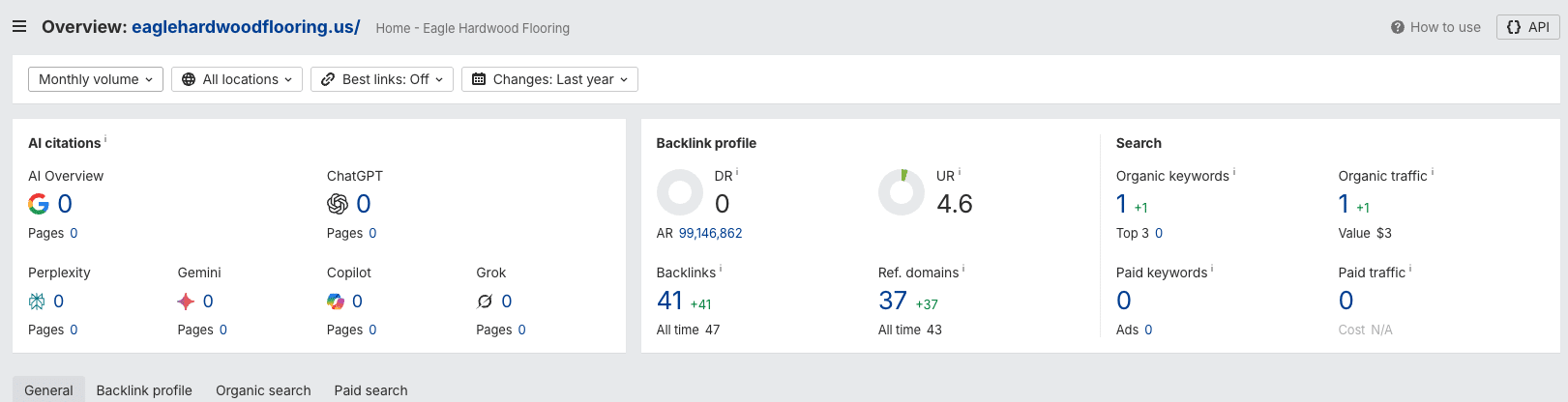
| Domain Rating | 0 / 100 |
| Organic Keywords | 1 |
| Organic Traffic | 1 visitor / day |
| Backlinks | 41 |
| Referring Domains | 37 |
| AI Search Appearances | 0 citations across AI platforms |
Look at those backlink numbers. Eagle Hardwood Flooring has 41 backlinks and 37 referring domains — that is a meaningful foundation. But they are generating a single daily visitor from organic search. The issue is not their link profile. The issue is what those links are pointing to and how the site itself is structured around keywords.
The gap between 586 visitors a day and 1 visitor a day is not a gap in budget. It is a gap in keyword strategy.
The Number That Changes Everything in 2026: AI Search Citations
There is one data point in this comparison that goes beyond traditional SEO — and it is the number that every flooring contractor needs to pay attention to right now.
Duffy’s Floors appears in 51 AI-generated search results. That means when someone asks Google’s AI Overview, ChatGPT, Perplexity, or Grok a question about hardwood floor refinishing in Boston, Duffy’s Floors is one of the businesses being cited and recommended. Eagle Hardwood Flooring appears in zero.
This matters more than it might seem. AI search is not the future — it is the present. Google’s AI Overviews now appear at the top of millions of search results before a single blue link is shown. ChatGPT has become a research tool that consumers use to find local service providers. Perplexity and Grok are pulling citations from websites with strong, well-structured content.
The businesses being cited by AI are the same businesses that Google already trusts in traditional search. You cannot shortcut your way into AI citations. You earn them the same way you earn rankings: by building authoritative, well-structured, keyword-focused pages that answer real customer questions.
Duffy’s Floors did not set out to “optimize for AI.” They optimized for search — and their 51 AI citations are the compounding reward for doing it right.
AI doesn’t find new websites. It amplifies the ones Google already trusts. Get the SEO right, and the AI citations follow.
Why the Gap Exists: The Keyword Targeting Problem
To understand how Duffy’s Floors pulled so far ahead, you need to look at how they approached keyword selection — and why most flooring contractors get this completely wrong.
The instinct for most contractors is to try and rank for the biggest possible terms. “Hardwood floors” sounds like an obvious target. Here is what the data says about that keyword:

| Monthly Search Volume | 9,500 |
| Traffic Potential | 27,100 visitors / month |
| Keyword Difficulty | 32 / 100 (Hard) |
| Referring Domains to Rank | 40 domains needed |
| Who Actually Ranks | Home Depot, Lowes, BuildDirect, Floor & Decor |
That traffic potential of 27,000 monthly visitors looks incredible on paper. But look at who is ranking: national retail giants with domain ratings above 58, thousands of backlinks, and dedicated SEO teams. A local flooring contractor does not belong in that fight — not because they are not good at their craft, but because Google has already decided this is a product keyword dominated by e-commerce.
The SERP for “hardwood floors” is not a local contractor search. It is a shopping search. Every result on page one is a listing collection or product page from a major retailer. No amount of good writing or local optimization is going to move a service-based contractor onto that page.
Now look at what happens when you stop competing with Home Depot and start targeting the specific searches your actual customers are making:

| Monthly Search Volume | 50 |
| Traffic Potential | 80 visitors / month |
| Keyword Difficulty | 13 / 100 (Medium) |
| Referring Domains to Rank | 15 domains needed |
| Who Actually Ranks | Duffy’s Floors |
Fifty monthly searches does not sound exciting until you consider who is doing those searches. Someone typing “hardwood floor refinishing Boston” into Google is not browsing. They are not comparing products. They are ready to hire someone. That is a high-intent search — and Duffy’s Floors owns it.
Their page for that keyword ranks #2 in organic results, drives an estimated 64 targeted visitors per month from that term alone, and generates traffic valued at $256 per month — all without spending a dollar on ads. Multiply that approach across 90 keywords and you get 586 visitors a day.
How to Build a Page That Actually Ranks: The Structure Behind the Results
Targeting the right keyword is only half the equation. The other half is knowing exactly where that keyword needs to live on the page. This is where a lot of flooring contractors do the research, find a good keyword, and then undo all their work by placing it in the wrong places — or not enough of them.
The principle is straightforward: one keyword per page. Each service page on your website should be built around a single, specific search term. For a flooring contractor in Boston, that might mean separate pages for:
- Hardwood floor refinishing Boston
- Hardwood floor installation Boston
- Floor sanding services Boston
- Engineered hardwood flooring Boston
Once you have identified your keyword for a given page, it needs to appear in all of the following locations:
- H1 Title Tag — the primary heading that appears at the top of the page
- Page URL — the web address should contain the keyword, not a generic string of numbers
- First 100 Words — signal relevance immediately; do not bury the keyword halfway down the page
- H2 and H3 Subheadings — weave the keyword naturally into section headers throughout the content
- Body Text — use it several more times in a natural, readable way
- Image Alt-Text — every photo on the page should have a descriptive alt tag that includes the keyword
- Meta Title — the title that appears as the clickable link in Google search results
- Meta Description — the short summary shown below your link in search results
Look at the SERP data for “hardwood floor refinishing Boston” and you will notice something about the pages that rank: they are focused, service-specific pages with 825 to 2,652 words of content. They are not homepages. They are not generic “our services” pages that list 15 different offerings in one place. They are single-purpose pages built around a single customer intent.
That level of specificity is what Google rewards — and increasingly, what AI platforms cite.
The AI Content Trap: Why Generic Pages Are Losing Ground
Here is a scenario playing out across the flooring industry right now: a contractor uses an AI writing tool to generate a service page in five minutes, publishes it to their site, and wonders why it is not ranking six months later.
The content looks fine on the surface. It mentions the service. It mentions the city. It hits the right word count. But Google has become very good at identifying content that could have been written by anyone about anything — and it does not reward that content with rankings or AI citations.
Before publishing any service page, ask yourself three questions:
- Could this content have been written by someone who has never done this work? If yes, add your actual process, your real-world experience, and your specific knowledge of the Boston market.
- Could you swap out “hardwood floor refinishing” for any other service and have it still read the same? If yes, the content is too generic to rank.
- Does this page answer a question that your customer actually has? Not a question Google wants you to answer — a question a real homeowner in your city is typing into a search bar.
The flooring contractors appearing in AI search results — the ones being recommended by ChatGPT and cited in Google AI Overviews — are the ones who wrote content that no AI tool could have generated on its own. They brought specificity, local knowledge, and genuine expertise to every page.
That is not just good SEO. That is the bar Google and AI platforms are now holding every local contractor to.
Putting It Together: The path from 1 Visitor a Day to 586
The gap between Duffy’s Floors and Eagle Hardwood Flooring did not happen overnight — and closing a gap like that does not happen overnight either. But the path is not complicated. It is a series of deliberate, repeatable steps:
- Step 1: Identify specific, low-competition keywords your local customers are actually searching for — not broad terms you cannot rank for
- Step 2: Build a dedicated service page around each keyword — one keyword, one page, every time
- Step 3: Structure each page so the keyword appears in every required location: H1, URL, meta, body, and image alt-text
- Step 4: Write content that is specific enough that a competitor could not copy and paste it for their own site
- Step 5: Build a modest number of referring domains to support your rankings — for a keyword like “hardwood floor refinishing Boston,” you need approximately 15
- Step 6: Repeat the process across every service and every geography you want to rank for
Do that consistently and the organic traffic compounds. So do the AI citations. Duffy’s Floors is not running one clever campaign — they are running a system. And the results speak for themselves: 90 keywords, 586 daily visitors, 51 AI search appearances, and not a single dollar spent on paid advertising to get there.
For a deeper look at which specific keywords are worth targeting for flooring contractors, read our full guide: Best SEO Keywords for Flooring Contractors.
How Can MarketKeep Help Grow My Flooring Business?
At MarketKeep, we help flooring contractors get to the top of Google Maps, reach the first page of search results, and get cited in AI searches. Our job is to close the gap between where your website is today and where it needs to be to generate consistent, daily leads — without paid advertising.
We handle keyword research, service page builds, on-page SEO structure, and the content strategy that earns AI citations. If your website is sitting at 1 visitor a day, there is a clear reason — and a clear path forward.
Learn more about what we do for flooring contractors: MarketKeep SEO Services for Flooring Contractors.
Contact us today to schedule a free SEO evaluation with our team.

